
The serious situation facing the planet and humanity has given rise to a number of movements, for ecological, food, and social justice. Increasingly, people are becoming aware that all these issues are related to land. The People’s Land Policy grew out of the Land Justice Network (LJN), which itself formed as a result of the 2017 Land for What? conference. This event was historic in many ways. It brought together people active specifically around land rights (e.g. This Land is Ours, Three Acres and a Cow, Scottish land reform campaigners), but also campaigners from a variety of different areas of struggles, including housing, food, and the environment. Its main message was that many struggles are essentially land struggles and therefore we need to work together to build a land justice movement.
Some of those involved in organising the conference, together with others who attended, wanted to carry on and build on what the conference started. Several meetings were held and the Land Justice Network was born. There were three main working groups: action, education and policy, but it must be stressed that they were seen as interrelated aspects of the same movement. Independently, some members of the LJN contributed to the Labour Party-commissioned Land for the Many report.[1] We in the Policy Working Group worked on a project called ‘People’s Land Policy’. The name was a reference to the successful work done by Land Workers Alliance and others on ‘The People’s Food Policy’. The thinking behind it was that we wanted to talk to as many people as possible and find out what they would like from land reform and let the policies emerge from these discussions: land reform from the ground up. This is different from approaches which gather together ‘experts’ to come up with the ideas which are then presented to people. When the LJN dismantled in 2019, we wanted to continue with our work so we set up a project using that name: the People’s Land Policy.
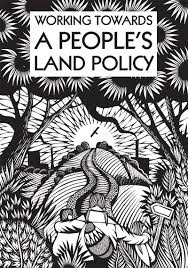
We published a pamphlet called ‘Working towards a People’s Land Policy’ in early 2020. We deliberately used the phrase ‘working towards’ as it was meant to be a document that was discussed and reviewed by people at the grass roots, with a view to developing, expanding and amending it together with others. Covid hit soon after it was published so we took the initiative to set up a series of seminars to discuss aspects of the document that were underdeveloped and needed expanding. We held 3 seminar series from 2020 to 2021- a total of 10 seminars in all. The first one focused on land and the environment, the second on land and food, and the third on land and democracy. All had a strong international component. We invited a range of speakers and hundreds of people attended at least one of the seminars. The end result was a wealth of ideas, perspectives and views which we collated into a number of reports. We also started the process of updating the original document.
However, we felt that we needed something that was shorter and more accessible, a document that could motive and stimulate campaigns and action. Hence, Towards a Manifesto for Land Justice, published in 2023.
Since then we have developed our ideas from further feedback and through events like the London Land Justice Fair. For this edition, we include a historical section in order to place ourselves within the tradition of resistance to dispossession.
Our Vision
We seek to revolutionise the land owning system, not just creating a more equitable distribution of land but a completely different land system: The Commons.
The Commons has been traditionally seen in terms of rights. Commoners had rights to use common land to graze livestock or take wood for fuel. Today only 3% of England and 12% of Wales is Common Land. However, Common Land is still owned by someone; it is not necessarily land that is collectively owned and managed for the public good. We see the Commons as being more than this. It is not just rights but the recognition that all the earth is a common inheritance, a gift of nature to benefit all in which we act as stewards or caretakers so that it can sustain us both now and in the future. In addition, it is a social process: ‘Commoning’, in which people work together within democratic and fully participatory structures to ensure ecologically responsible production and equitable distribution of the land’s wealth and to create resilient communities of care, embedded in place. Those who are involved in the process of Commoning are ‘Commoners’.
This model stands in contrast to the current land owning model based on private ownership.
Strategy
The realisation of this vision will not happen over night. Those of us in the People’s Land Policy are also active in grass roots campaigns (food, housing, communities). Policy is not something that only politicians and NGOs do- it is basically demands and ideas for change that come from the aspirations and concerns of ordinary people. One strand of our strategy would be a Land Reform Act for England and Wales, similar to the ones passed in Scotland. This would be a step in the right direction. However, we realise that without a mass movement, effective change is not possible and we need to organise on a number of fronts to build land reform from the ground up.
As part of building such a mass movement we organised two Land Justice Fairs in London and set up the London Land Justice Group. This has enable us to bring a variety of people together to focus on land issues in a practical way. Part of our stratgegy is to campaign for a London Land Justice Charter.
 People's Land Policy